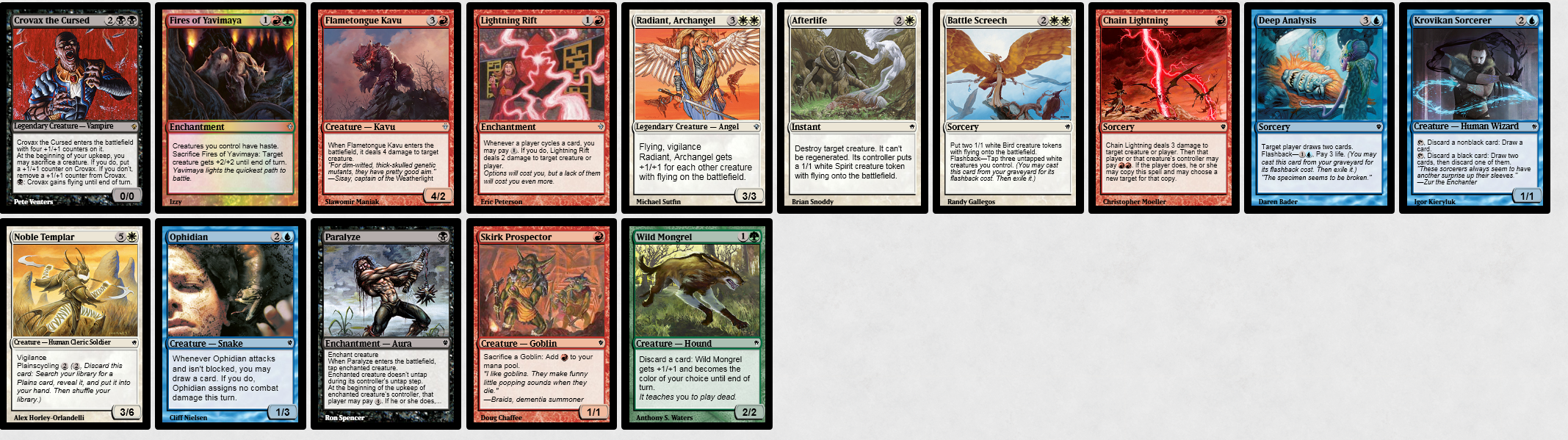
Vintage Rotisserie Draft.
It’s perhaps the deepest the Magic rabbit hole goes. (Maybe mental Magic is deeper? If you consider that a thing) (I don’t.)
I remember seeing these done with pro players on spreadsheets a few years ago. They seemed like a cool exercise and discussion starter, but they rarely played out the games. They also seemed fairly intimidating for someone who isn’t totally familiar with every card in Magic’s long history.
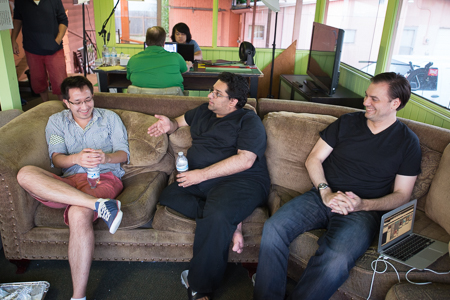
Brian and I getting Zaiem Begged
A quick explanation of what a Vintage Rotisserie Draft (VRD) is, is probably in order.
How it Works
Imagine a booster pack that contained every legal card in Vintage. Every one; Black Lotus, Ancestral Recall, Mana Crypt, Dark Confidant, Man O-‘War, all of them. That’s the booster pack that you are drafting from in VRD.
It’s an eight person draft, and the seats are set ahead of time. (I was in Seat 7, for example). The first seat takes their pick (it’s been Black Lotus for all eight of the VRDs that have happened so far), and the players pick cards in order down the line. Once you get to the eighth pick, the draft “snakes” back in the other direction—the player with the eighth pick gets the ninth pick as well. The draft then continues backwards until it loops back around in the same fashion.
Players draft forty-five cards total, and play forty card decks.
Kind of absurd forty card decks if I’m honest.
In order to facilitate drafting literally any card in Vintage, players draft on a shared spreadsheet, which is updated in real time. Then each player plays against every other player, round robin, with the top two players playing a best-of-five match to determine the champion.
The player with the worst record also wins a prize. It’s called the Jed, and you don’t want it. It’s a mark of shame that is spoken of from the earliest moments of the draft.
Perhaps the coolest part about this whole thing is that a bunch of local Magic players are taking it to the masses via live stream.
The stream is called Shotgun Lotus (get it?) and they have streamed these VRD drafts which will ultimately culminate in a champions VRD in September. It’s amazing what these guys have been able to do on a smallish budget, and with, ahem, limited resources.
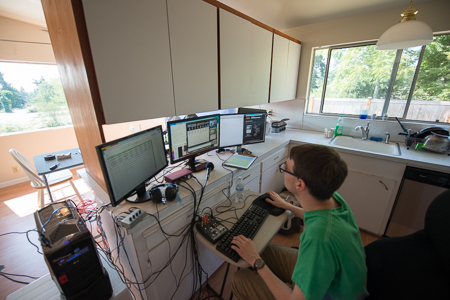
At the helm. Also, in the kitchen.
When I am in the booth at a GP or the Pro Tour, I have to keep in mind that our audience is massive, and not all as hardcore into Magic as you or I. I strive to make the game accessible to newer players, while not talking down to the enfranchised players. It’s a fine line to walk, and I’m always trying to tune it to the best of my ability.
But with Shotgun Lotus, the line is thrown out the window. This is this most hardcore Magic thing you can do, and the guys that run it simply own up to it. If you are watching the stream, they assume you know the cards, stories, interactions, decks, and references. I think it’s great.
They are also working with my booth partner and friend Randy Buehler on a Vintage Super League, which looks super promising.
I’m curious to see where this goes for the Shotgun Lotus guys. I’m hoping it really takes off and becomes a “thing”, and I’m going to do what I can to help.

Randy and James have a frown-fight in the feature match area
Tournament Recap
I’m not going to go round-by-round or anything, but I’ll explain what my pre-draft process was and how it all came out.
I had long chats with Rashad Miller and Charles Wong (who one a VRD already) about what kind of deck I should draft. My goal was to do something off the map. I didn’t want to fight for all the cards that everyone else wanted.
It’s tempting to use known Vintage decks as the framework for a draft deck, but the fact is that since you can’t get any more than a single copy of a given card, it’s difficult to have redundancy in your deck. The tutors of varying types go fairly early, so you can’t count on getting those.
Rashad and I brewed a Lands deck, which would abuse Strip Mine, Wasteland, Life from the Loam, and Crucible of Worlds. I actually had a deck outlined and was planning on drafting it. I took Mox Ruby with my first pick, and when Jesse Wilke took two broken artifact mana-makers, I took Strip Mine.
This is a little early for Strip Mine, but my plan was clear: If I was able to I’d draft the Lands deck I wanted, but if not Strip Mine went quite nicely into my backup deck: Blue-Black Tempo.
Blue-Black Tempo is my favorite deck to draft in cube, and I had sketched out a workable list for the VRD. If I ended up in this strategy, I would be fighting two to four people for cards in the early stages of the draft, but I was hitting from a different enough of an angle that I could get key pieces for the deck last pick if I wanted.
The deck works like this: You draft a mono-black aggro shell (think Carnophage, Rakdos Cackler, Gravecrawler, basically any one-drop with two power) and then back that up with cheap black and blue cards. The cheaper the counterspell the better, same with the discard spells. Force of Will, Force Spike, Daze, Spell Pierce, Thoughtseize, Inquisition of Kozilek, Duress. We want all of it.
The plan is to play a one-drop on turn one, maybe two of them on turn two, then protect the assault. You get to disrupt the opponent through tempo plays while assaulting their life total. You also will disrupt their mana with cards like Strip Mine, Wasteland, Rishadan Port and Sinkhole.
That was my Plan B. But I was still on Plan A until Chris Kelly took Fastbond unprecedentedly high (it was his second pick!). Fastbond is an absolute must-have card for the Lands deck, so that dream died right there.
Thusly, I switched into Plan B.

Do I take the token out?
Honestly I was a little relieved. The Lands deck looked fun, but I haven’t played a deck like that before and would have been figuring out a ton of it along the way. Additionally, that kind of deck isn’t what I really want to do in Magic anyway.
I picked Snapcaster Mage for my next pick (though I wonder now if Dark Confidant would have just been a better pick), then Spell Pierce, Daze, and Vendilion Clique before pivoting into black for Inquisition of Kozilek, Bitterblosson and Liliana of the Veil.
Knowing that I could take my one-drop creatures the last eight or so picks of the draft was a luxury, but I was fighting hard with both James Nguyen and Corbett Gray. I didn’t get all the pieces I wanted, but I did pick up a decent amount.
The two curveballs that I got to try out in this format (they aren’t in any of the cubes I have played) were Standstill (my buddy Woody’s idea) and Sygg, River Cutthroat (my idea). Sygg is fantastic with all the cheap aggressive creatures, and is easy to cast to boot.
Both over-performed for me all day. I drew three cards off of Standstill every time I cast it, and Sygg probably drew me eight or nine extra cards on the day.
I also had some devastating possible opening plays:
Turn 1: Carnophage
Turn 2: Bitterblossom or Pack Rat
Turn 3: Vampire Lacerator, Standstill
Yikes.
My deck topped out at three mana, and was deadly consistent. The big concern I had was whether the overall power level was there. Remember, in this format people are making Blightsteel Colossus on Turn 2.
Or Griselbrand on Turn 2. I faced Jace, the Minsculptor on Turn 1! (I Dazed the living hell out of that!) Taking infinite turns, milling you out, all very early in the game.
I thought my strategy itself was sound, but I knew I would be fighting for the good blue and black spells (considered the two best colors in Magic historically speaking). As it turns out, I felt like my deck fell just a bit shy after the build.
It really needed the Dark Confidant and the Thoughtseize. Those were huge cards for me, and they were missed.
I ended up playing Randy in the first round, on camera.
You can watch the match here, at the 03:03:14 mark
It was pretty cool being in the feature match area. I’ve been there once at a GP, and I enjoy it a lot. The fact that Brian Wong was commentating made it even more interesting.

Paul Waite and super special and hansom guest commentator Brian Wong
I have played against the Infect deck before, and I know better than to give my opponent any opening whatsoever. Randy mulliganed twice in game two, and I played aggressively conservative bouncing his infect creature on my turn whenever possible.
I won my next match to start out 2-0, but then lost the next five to finish 2-5. I wasn’t shocked with the record, but I was a little disappointed. My idea worked; the deck performed well, and I was quite happy with my play overall. I got smashed in two of the matches (both Jesse’s killed me good) but the rest of them were good close games.
I got a game off of the ultimately undefeated Corbett Gray, and had him firmly on the ropes in game three with him needing to draw a flyer or removal, and also needing me to not draw removal or bounce. He drew the flyer, and I didn’t draw the bounce, and he killed me. His deck was absurd, and he played great all day earning a much deserved victory.
I think my deck was two or three cards away from being in the conversation for making the final two. Unfortunately two or three cards is a lot.
The day went long, but my brain is still buzzing about what I would do if I get another shot at a VRD…
My brain is also buzzing about the twenty *pounds* of chicken we ate.
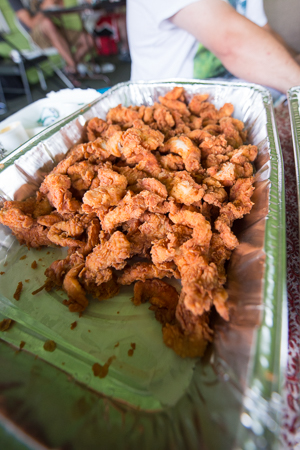
This is half of half of what we ate.
(And yes, I took Man O-‘War. Partly because, well you know. But also because I think it’s secretly good out of the sideboard against the reanimator decks.)
– Marshall